Bookmark this: Reading before bed works best on a clock. An hour out, dim the house and get quiet. At thirty minutes, park your phone in another room. Read a calm paper book for fifteen to thirty minutes under one soft lamp, stop at a point you picked earlier, and switch off the light when your eyes get heavy.

This guide is for anyone who keeps meaning to start reading before bed and keeps ending the night in a scroll instead. It’s also for the reader whose nights sometimes end at 2 a.m., three chapters later.
You’ll get a 60/30/10-minute wind-down, an honest look at the two studies everyone quotes, a bed-or-chair table, a paper vs e-reader vs phone comparison, and stop rules for books that won’t let go. This is general sleep-hygiene guidance, not medical advice. You don’t need a perfect routine, just one you’ll repeat.
Your wind-down, minute by minute
- 60 minutes before sleep: Start quiet time. TV off, main lights dimmed, tonight’s book chosen.
- 45 minutes: Teeth, water glass, tomorrow’s bag. Reading comes after everything else.
- 30 minutes: Phone goes to charge outside the bedroom. Settle in your chair or bed with one soft lamp aimed at the page.
- 30 to 10 minutes: Read. Fifteen to thirty minutes is plenty, and a few pages count too.
- 10 minutes: Stop at the point you marked, close the book, lamp off.
- If 20 minutes pass awake: Get up, go somewhere dim and quiet, and come back when you feel sleepy. No screens.
Does reading before bed actually help you sleep?
For many people, yes. In The People’s Trial, a randomized trial of 991 adults, 42% of those asked to read a book in bed for a week said their sleep improved, compared with 28% of those who didn’t read. Some readers slept worse, though, so treat it as a habit to test, not a cure.
The full study was published by Finucane and colleagues in the journal Trials in 2021. Readers were asked to read for 15 to 30 minutes immediately before trying to sleep, for seven nights, then rate their sleep quality on a single question.
Two details rarely make headlines. The sleep score was self-reported, not measured in a lab. And the trial’s own results page notes that 10% of the reading group (37 people) felt their sleep got worse.
The Sleep Foundation’s guide to reading and sleep, medically reviewed by Dr. Dustin Cotliar, sums up the research this way: people who read before bed generally sleep better, wake up less often and sleep longer than people who go to bed without reading.
Readers report something similar. In a r/books thread with more than 3,800 upvotes, one reader described how swapping scrolling for reading in bed led both them and their spouse to fall asleep faster. So the small rule is this: judge the habit after a week, not after one night.
How long should you read before bed?
Fifteen to thirty minutes is a sensible target for reading before bed, because that’s the window The People’s Trial asked its readers to use. If thirty feels like too much, start with five or ten minutes. A short, repeatable session builds the habit faster than an ambitious one you skip.
The Sleep Foundation describes a bedtime routine as the same activities in the same order in the 30 to 60 minutes before bed, and it suggests putting electronics away at the start of that routine. The National Heart, Lung, and Blood Institute goes a little earlier, advising people to use the hour before bed for quiet time and to avoid bright artificial light such as a TV or computer screen.
That’s where the 60/30/10 timeline comes from:
- 60 minutes out lines up with the NHLBI’s quiet hour.
- 30 minutes out matches the American Academy of Sleep Medicine’s advice to turn off electronic devices at least 30 minutes before bedtime.
- The reading window borrows the trial’s 15 to 30 minutes.
- The last 10 minutes are for closing the book while you’re still drowsy, not wide awake.
Keep the same start time most nights. The routine is the signal, so timing matters more than page count.
Is reading in bed bad for sleep?
Reading in bed is fine for most people who fall asleep easily, and it’s where The People’s Trial readers read. If you often lie awake, though, sleep experts suggest keeping the bed for sleep, reading in a chair until you feel sleepy, and only then getting into bed.
The American Academy of Sleep Medicine’s healthy sleep habits list includes “use your bed only for sleep and sex”, and the Sleep Foundation’s routine guide says it’s best to read outside the bedroom with soft lamp light. The academy notes these habits are part of cognitive behavioral therapy for insomnia, which it calls the most effective long-term treatment for chronic insomnia.
Readers argue about this too. In a r/sleep thread asking whether reading in bed hurts sleep, the poster’s partner insisted she should only read in chairs. One reply said they’d been advised to read in an armchair and get into bed once tired. Another said that when sleep is a “chaotic minefield”, the bed should be guarded for one thing only.
| Your nights look like this | Where to read | Why |
|---|---|---|
| You usually fall asleep within a few pages | In bed is fine | The habit already works for you |
| You lie awake most nights | A chair, then bed when sleepy | Matches the AASM bed-for-sleep advice used in insomnia treatment |
| You share a bed with a light sleeper | A chair or another room | Your lamp stays out of their eyes |
| You wind down after shift work or a late night | Wherever is dimmest and quietest | Low light and quiet matter more than furniture |
Don’t have a chair? A floor cushion against the wall with a lamp beside it works too. Whichever you pick, keep it the same spot every night, so the place itself becomes part of the signal.
Paper, e-reader or phone: which is best for reading before bed?
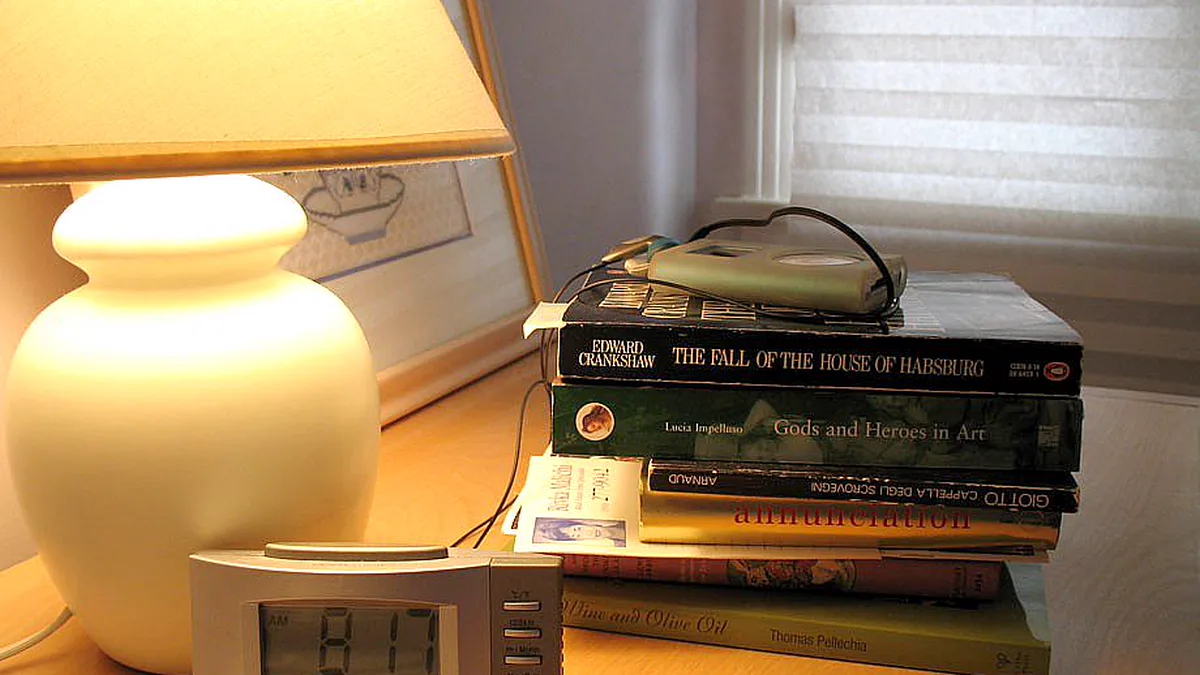
A paper book is the safest choice for reading before bed, according to the Sleep Foundation, because every e-reader gives off at least some blue light. A dimmed e-reader that holds only books is a reasonable second choice. A phone is the weakest option, mostly because everything else on it is one tap away.
The study behind most screen warnings is worth reading closely. In a 2015 sleep study published in PNAS, Anne-Marie Chang and colleagues had 12 healthy young adults read either a printed book or a light-emitting tablet (an iPad) for about four hours before bedtime on five evenings in a row. After the tablet, they took nearly 10 minutes longer to fall asleep on average, their evening melatonin was suppressed by about 55%, their melatonin rise came more than 90 minutes later, and they felt less alert the next morning.
That’s a strong result, but notice the conditions: twelve people, a tablet, around four hours a night. A bedtime read is usually far shorter, and the study didn’t test a dimmable e-ink reader. That’s why the Sleep Foundation’s guide stays cautious, saying that while some e-readers let you limit blue light, all of them emit some, so hardback or paperback books are the better choice “for now”.
| Format | What the evidence says | Practical rule |
|---|---|---|
| Paper book | The comparison condition in the Chang study | Use one soft lamp aimed at the page |
| E-reader | The Sleep Foundation says all models emit some blue light | Lowest brightness, warm setting, books only |
| Tablet or phone | The tested device in the Chang study; the AASM advises devices off 30 minutes before bed | Last resort, and never in the final half hour |
Some readers pick an e-reader because it can’t scroll. In a r/adhdwomen thread from someone who kept sliding back to doomscrolling instead of reading before bed, the top reply was simply an e-reader, because there’s no way to doomscroll on it. If your library books only open in a phone app, read them earlier and keep paper for the last half hour.
What should you read before bed?
Choose something calm, familiar or gently paced: a reread, short essays, poetry, a cozy mystery you’ve already solved, or nonfiction in short chapters. The Sleep Foundation suggests avoiding horror, thrillers and page-turners that might keep you up past your usual bedtime.
The Sleep Foundation’s routine guide adds that a simple or uneventful plot can be best. Bedtime isn’t where you need your most gripping book, so keep two going:
- The day book: the thriller or big novel you can’t stop thinking about. Read it on the train or at lunch.
- The night book: something you enjoy but could put down mid-sentence. Rereads are perfect, because you already know what happens.
If you’re coming out of a slump and nothing feels right, the plan in how to get back into reading starts with short, easy books that suit the night shelf.
How do you stop at one more chapter?
Decide where you’ll stop before you start, and make that point mid-chapter, not at the end. Chapters often finish on a hook, so stopping at a quiet paragraph a few pages earlier is easier. Keep page-turners out of the bedroom and pick the stop page during your 60-minute wind-down.
This is the loudest complaint about reading before bed. One post on X with more than 2,500 likes called the fall-asleep promise the biggest lie, because the writer ends up awake until 3 a.m. In the r/books thread, a reply with more than 50 upvotes described the same spiral: one more chapter, and suddenly it’s dawn.
Small rules that help:
- Mark the stop page with a sticky tab when you open the book. Done means done.
- Stop on a calm scene, not a cliffhanger. Skim ahead a page to find one.
- Read the first page of the next chapter at breakfast instead, when the hook works in your favor.
- Swap books if it happens three nights running. That book is a day book now.
Still wide awake? The American Academy of Sleep Medicine’s 20-minute rule applies: get up, do something quiet in low light with no electronics, and come back when you’re sleepy.
What light do you need for reading in bed?
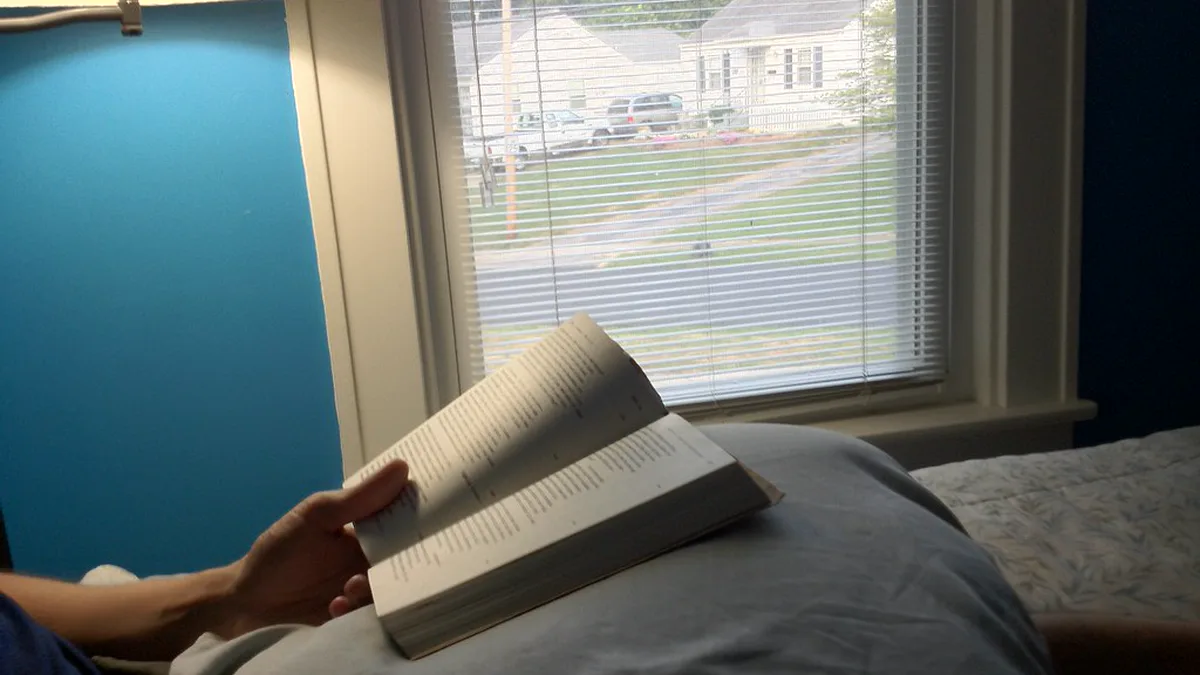
For reading in bed, use one soft, warm lamp aimed at the page and keep the rest of the room dim. You want enough light to read without squinting and as little as possible spilling across the bed. Turn the lamp off the moment you close the book.
Light in the evening matters even when it’s dim. Harvard Health Publishing notes in “Blue light has a dark side” that a mere eight lux, a level most table lamps exceed, can affect melatonin and circadian rhythm. It also suggests dim red lights for night lights.
The goal is a small pool of light on the page:
- Point the lamp at the book, not at your face or your partner’s pillow.
- Keep the switch within arm’s reach so lights-out takes one move.
- Dim or switch off overhead lights at the 60-minute mark.
- Use a dim red night light if you need to walk around later.
For bulb brightness and color temperature, the reading nook guide’s lighting section has the details.
Reading before bed myths, and what actually helps
A few beliefs make the habit harder than it needs to be.
| Myth | What actually helps |
|---|---|
| Reading before bed always makes you sleepy. | Test it for a week. In The People’s Trial, 42% of readers said their sleep improved, but 10% said it got worse. |
| Any book will do at bedtime. | Keep horror, thrillers and page-turners for daytime, as the Sleep Foundation suggests, and save a calm night book for bed. |
| You need a full hour of reading. | The trial asked for 15 to 30 minutes. Five minutes a night still builds the habit. |
| An e-reader is exactly as bad as a phone. | The famous study tested a tablet for about four hours. Dim your e-reader and keep it book-only, though the Sleep Foundation still favors paper for now. |
| If you can’t sleep, keep reading in bed until you do. | After about 20 minutes awake, the AASM suggests getting up for a quiet, low-light activity away from screens. |
If you’d rather listen than read at night, the comparison in audiobooks vs reading walks through what each format is good for. You’ll find more small, guilt-free routines in the section on everyday reading routines.
So which book is going on your nightstand tonight?
Between chapters
Is it okay to fall asleep while reading?
Lots of readers do, and drifting off is the point. Keep a bookmark on the nightstand, use a lamp you can switch off without sitting up, and put glasses within reach. If you wake with the light still on, move lights-out ten minutes earlier.
Do audiobooks work as a bedtime routine?
They can be part of a wind-down, but the Sleep Foundation says audiobooks don’t have the same benefit on sleep quality as reading. Use a sleep timer so the story stops on its own, and pick a narrator with a calm voice.
What if your partner wants the light off?
Read in a chair or another room, then get into bed in the dark. If you read in bed, use a small lamp aimed only at your page and agree on a lights-out time together.
Can you read before bed on a phone with night mode?
You can, but it’s the hardest version of the habit. The American Academy of Sleep Medicine advises turning devices off at least 30 minutes before bed, and a phone keeps every app one tap away. Save phone reading for earlier in the evening.
What if reading before bed keeps you awake every night?
Move your reading earlier and out of the bedroom, switch to a calmer book, and follow the 20-minute rule. If falling asleep is hard most nights, mention it to a doctor; sleep habits are one part of insomnia treatment.
How we researched this: No publisher paid for placement. The draft was machine-assisted; titles, dates and formats were re-checked by the writer against library catalogs.
Sources: Finucane and colleagues, The People’s Trial, Trials, full paper (2021); Chang and colleagues, PNAS, full paper (2015); Sleep Foundation, reading and sleep (updated 2026) and bedtime routine for adults (updated 2025); American Academy of Sleep Medicine, healthy sleep habits; National Heart, Lung, and Blood Institute, healthy sleep habits; Harvard Health Publishing, blue light and sleep; reader discussions on r/books, r/sleep and r/adhdwomen.
Leave a Reply
You must be logged in to post a comment.