Bookmark this: The short answer to how to organize bookshelf space: sort by the cue you actually remember books by (genre, author, color or size), then put heavy books low, everyday reads at hand height and a little empty room at each shelf’s end. Keep every book upright, out of direct sun and out of damp rooms.
This guide is for anyone staring at a shelf that used to make sense, or hunting for a book you know you own.
You’ll get eight bookshelf organization ideas compared side by side, a test for picking one you’ll keep, small-room fixes and the shelf-care basics the Library of Congress recommends. Nothing to buy. Your shelf only has to work for you.
If you’re also setting up a chair and a lamp next to those shelves, the reading nook ideas checklist covers seating and light, so this page sticks to the books themselves.
A two-hour shelf reset, one section at a time
- Minute 0: Clear one shelf, not the whole case. Dust it with a dry, unscented cloth while it’s empty.
- Minute 15: Sort that shelf’s books into four rough piles: reading now, reach for often, keeping for the long haul, ready to pass on.
- Minute 30: Run the recall test below and pick one main sorting cue.
- Minute 45: Shelve the heaviest books lowest and the books you grab every week between hip and eye height.
- Minute 90: Leave a hand’s width of space at the end of each shelf for new arrivals, and add a bookend wherever a row starts to lean.
- One week later: Try to find three books without searching. If two of them took more than a few seconds, change the method, not your memory.
What is the best way to organize a bookshelf?
The best way to organize a bookshelf is the one that matches how you remember books. If you recall subjects, sort by genre. If you recall names, go alphabetical by author. If you picture spines, color can work. Then add a second rule inside the first, like author within genre, so every new book has an obvious spot.
That’s why every “right way” argument online goes in circles. In an r/books thread asking how people organize their bookshelves, one reader said they’re function over looks: fiction apart from nonfiction, then subject, then size, because they’re bad at recalling a book’s color or its exact title. Over in r/bookshelf, the same question drew the opposite answer from a reader who sorts by color, remembers where each spine lives, and often forgets authors’ names.
Both are right; they just remember different things. So when you think of a book you own, what pops into your head first?
8 bookshelf organization ideas compared side by side
Every method trades something. This table compares eight common bookshelf organization ideas on the two things that decide whether a system lasts: how you find a book, and what happens when a new one arrives.
| Method | How you find a book | When a new book arrives | Where it breaks down | Best for |
|---|---|---|---|---|
| Genre or subject | You remember what it’s about | Easy: it joins its group | Books that straddle two genres | Mixed collections and nonfiction |
| Author A to Z | You remember who wrote it | Shift a few books along the row | Full shelves, since every insert ripples down the line | Fiction readers and rereaders |
| Color | You picture the spine | Slot it into its color band | Series with mismatched spines, and covers that differ from spines | Small collections you know well |
| Size or height | You remember roughly where it sits | Goes wherever the height matches | Finding one title in a big collection | Tight shelves and protecting covers |
| Read vs unread | You know whether you’ve finished it | Starts on the unread side, moves once finished | The unread side grows faster than the read side | Readers who want a nudge toward books they already own |
| To-be-read shelf | It’s one short row at hand height | Joins the row only if a slot is free | The row spills onto a second shelf | Anyone who buys faster than they read |
| Frequency of use | Daily books sit closest | Starts further away until you reach for it | Habits shift, so it needs a seasonal rethink | Cookbooks, reference, favorites |
| Layered (genre, then author) | Two cues narrow it fast | A clear spot every time | Takes the longest to set up | Collections past a few hundred books |
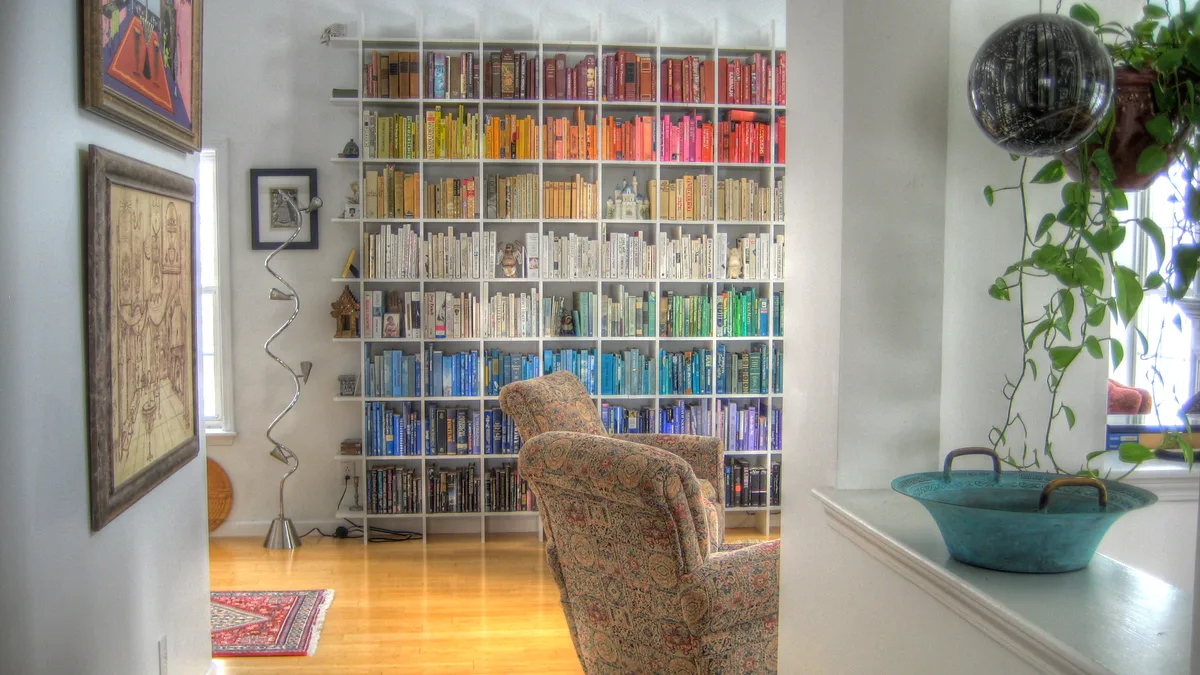
Color is the method people argue about most. Hannah Gersen, writing for The Millions, tried a color sort once and kept hunting for books she was sure were red, only to find their spines were blue. If you love the look anyway, keep each series together as one block and place it by its first book’s color.
The to-be-read shelf only works if it stays short. When it starts taking over, the guide to keeping a to-be-read list you’ll actually use covers pruning and library holds, so the shelf can stay one row.
How do you pick a method you’ll actually keep?
Pick a method by testing it on your own memory, not by liking a photo. Think of five books you own and write down the first thing you recall about each: subject, author, cover color or rough size. Whatever cue shows up three or more times becomes your main sort. Then choose a second cue for inside each group so additions stay simple.
Without a second cue, a genre shelf turns into a jumble within months. Readers who stick with a system stack rules, and that r/books thread is full of examples:
- Fiction strictly alphabetical, nonfiction by subject. One commenter keeps it exactly that simple.
- Fiction or nonfiction, then genre or subject, then paperback or hardback, then author, then title, from a reader with roughly 500 books.
- Series kept in publication order, and authors who write under two names filed under the name they’re best known by.
- Favorites on the two most reachable cases and everything else further away, rearranged whenever new books come in.
Groups can follow different rules. One r/bookshelf member sorts fiction by author but files cookbooks by the cuisine’s country. Another started sorting by weight after heavy art and architecture books bent a few shelves; those now live on the bottom.
The top reply in the r/books thread had the most honest answer of all: no order, because the family never puts books back. So here’s the real test of any system: could someone else in your home return a book to the right spot without asking you?
How to organize bookshelf space when you own a lot of books?
To organize bookshelf space when you own a lot of books, split the collection by format before you sort by content. Give small paperbacks their own shelves, keep tall, heavy books on the bottom, broaden your categories and double-row only the books you rarely pull out. Most capacity problems are really height and depth problems.
One r/bookshelf member with between 1,100 and 1,200 books on three 72-inch cases and a few 30-inch ones described exactly this. Mass market paperbacks got their own shelving, alphabetical by author. Nonfiction moved from Library of Congress call numbers to broader groups like science, history and languages so it would fit. Books to read and not keep got a separate shelf, and rows went two or three deep.
A few rules make a big collection easier to live with:
- Set shelf heights to your paperbacks. Shelves spaced for hardcovers leave empty air above small books; lowering one adjustable shelf can free room for another row.
- Put the tallest, heaviest books lowest. They’re steadier there, and a shelf that bows under weight is telling you something.
- Double-row the back, not the front. Put books you rarely reach for in the back row and keep everyday picks in front.
- Keep a pass-on spot. A box by the door for books leaving the house stops them from quietly reclaiming shelf space.
Double rows hide books, so tuck a list of each back row inside a front-row book. Which shelf would gain a row if you lowered it an inch?
What works in a small room or a rental?
In a small room or a rental, go vertical, keep the number of shelves low and give each shelf one job. Choose one tall case over several short ones, lay a few books flat to act as built-in bookends, and keep only this year’s reading and rereading in the room. Then anchor that tall case to the wall.
The U.S. Consumer Product Safety Commission’s Anchor It! campaign says anchoring furniture with drawers, doors and shelves to the wall prevents tip-over injuries and deaths. If you rent, get your landlord’s yes in writing before drilling.
Small-space bookshelf organization ideas that don’t need tools:
- The one-shelf rotation: keep a single shelf for what you’re reading now and next, and store the rest in a lidded box in a closet, swapping a few titles each season.
- Horizontal stacks as bookends: lay four or five books flat at the end of a row to hold the upright ones steady.
- Furniture you already have: a windowsill looks charming, but it puts books in direct light. The top of a dresser away from the window is kinder to covers.
Stacking has a cost. A reader in the r/books thread who moved from several big bookcases to one small shelf likes a planned-messy mix of stacks and rows, but admits the bottom books are harder to reach. Keep the ones you rarely open at the bottom. For more ways to carve a reading corner out of a tight room, browse the reading nook guides.
How do you keep books from fading, warping or growing mold?
Keep books cool, dry, dim and upright. The Library of Congress guide to storing books recommends 70°F (about 21°C) or below, relative humidity between 30 and 55 percent, minimal light, and no storage in basements, attics or garages. Shelve books so they stand straight without leaning, and use bookends wherever a row slumps.
The same guide covers the details most styling posts skip:
- Light fades covers. The guide shows a purple cover turned yellow by bright light. Keep displays out of direct sun, or close a curtain during the brightest hours.
- Heat and damp do slow damage. Avoid spots near vents and radiators, and rooms with big swings in temperature or humidity. Steady conditions protect the binding and help prevent mold.
- Match your neighbors. Shelve books of similar size together so each cover is supported by the books on either side.
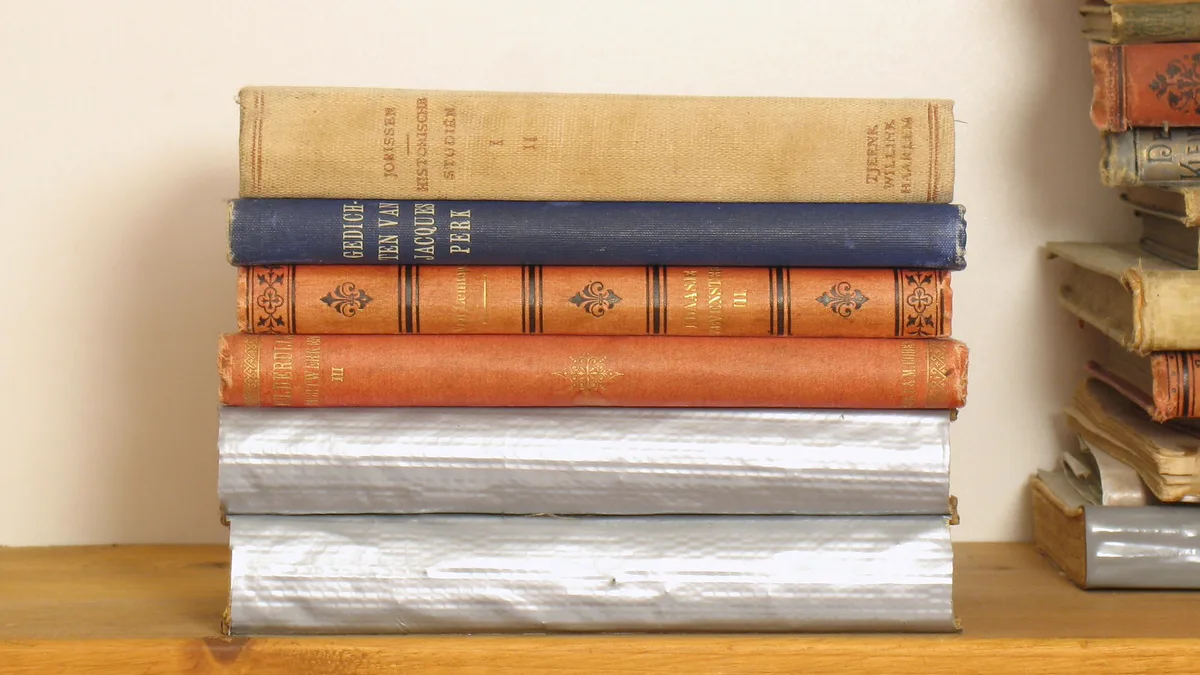
- Oversized books can lie flat. Books too tall to stand can rest flat, fully supported by the shelf. If one has to stand, put the spine down, never up, because gravity can loosen the pages from the cover over time.
- Solid shelves only. Shelves should be completely flat, free of nails or splinters, with a solid surface rather than slats or lattice.
- Dust without perfume. Dust can discolor books, attract pests and hold moisture, so use an unscented duster.
How you take a book off the shelf matters too. The Library of Congress page on handling your books says to push the neighboring books in on both sides and grip the book at the middle of its spine, instead of tugging at the top of the spine, which can damage it.
None of this rules out a color display or a stack. Just build it out of direct sun and away from the radiator. Small rule: if a shelf gets a patch of sunlight at any hour, it’s a plant shelf.
Bookshelf myths, and what actually helps
| Myth | What actually helps |
|---|---|
| Color sorting is only for looks. | Some readers find books faster by spine color, like the r/bookshelf reader who often forgets authors’ names. It works best for smaller collections. |
| Stacking books flat ruins them. | The Library of Congress says oversized books are fine lying flat when fully supported. The habit to avoid is standing a book spine up. |
| A sunny window shelf is the coziest spot for books. | Bright light fades covers. Keep the books in the shade and give the window to a plant. |
| One system has to cover every book you own. | Mixed rules work: fiction by author, nonfiction by subject, cookbooks by cuisine. |
| Bookends are just decoration. | They keep rows upright, which is exactly what the Library of Congress asks for once a shelf isn’t full. |
Start with one shelf this weekend. Which cue will you sort it by?
Between chapters
Where do titles that start with “The” go on an alphabetical shelf?
Most people file them by the next word, so a title like The Long Way Home sits under L. Whichever rule you choose, use it for every book, and note it on an index card inside the case so the rest of the household follows it too.
How do you keep a series together when the spines don’t match?
Shelve the series as one block in reading order, then place the whole block by author or by the first book’s color. Splitting a series across a color sort makes the next book hard to find and easy to buy twice.
How often should you reorganize a bookshelf?
Only when finding or adding books starts to feel slow. A light check once a season, while you dust, is plenty: pull finished books you won’t reread, close gaps and move this season’s favorites to hand height.
Is it okay to keep books in a basement, attic or garage?
The Library of Congress advises against it, because poorly insulated spaces usually have unsuitable temperature and humidity and a higher risk of leaks and floods. A closet in a lived-in room is a safer overflow spot.
How should you take a book off a crowded shelf?
Push the books on either side back slightly, then grip the book on both sides of its spine at the middle and slide it out. Hooking a finger over the top of the spine is the habit to break, because it can damage the spine.
How we researched this: Book details (publication dates, series order, formats) are checked against the publisher and library catalogs. AI helped with an early draft; the writer rewrote it and checked every title.
Sources: Library of Congress, Preserving Your Books research guide (Storing Your Books; Handling Your Books); U.S. Consumer Product Safety Commission, Anchor It! campaign; The Millions, Hannah Gersen, “Ten Ways to Organize Your Bookshelf” (2017); reader discussions on r/books and r/bookshelf.
Leave a Reply
You must be logged in to post a comment.