Bookmark this: The best reading journal ideas are the ones you’ll still use in March: a one-line log for every book, a full page only for the books that stay with you, a quote page sorted by headings, and a few prompts you answer right after finishing. Paper or an app both work. Pick the one you’ll actually open.
These reading journal ideas are for anyone who bought a lovely notebook, filled four pages in January, then let it sit on the shelf feeling a little guilty. They’re also for the reader who loves a book and can’t recall a scene six months later.
You’ll get twelve page ideas, thirty book journal prompts sorted by when you’d write them, a digital vs paper table and a four-week setup. No drawing skills needed. If you write in your books too, the guide on how to annotate a book with a simple symbol key pairs well with the journal.
Your first four weeks with a reading journal
- Week 1: Set up only two pages: a numbered book log and a quote page. Log the book you’re reading now, even if you’re halfway through it.
- Week 2: When you finish a book, answer three “right after” prompts from the list below. Five minutes.
- Week 3: Add one page you’re curious about: a TBR list, a DNF page or a mood tracker. Just one.
- Week 4: Keep the pages you filled without being reminded and drop the ones you skipped. Missing a week later on changes nothing.
What should you put in a reading journal?
Put in the few details you’ll want later: the title and author, the dates you started and finished, a quick rating or one-word verdict, a line or two about how the book made you feel, and any sentence you’d hate to lose. Everything else is optional.
A reading journal, also called a book journal, is a notebook or file where you record what you read and what you thought about it. It can be a list, a scrapbook or one page per book.
When a student asked on Reddit’s books forum what people who journal while reading actually write down, the most upvoted reply listed characters and what drives them, details that keep repeating, things to look up, what the book taught them, and how it made them feel. Another reply said there’s no wrong way: the journal is a place for how the book affects you.
Choose two or three of those and ignore the rest until you miss them.
12 reading journal ideas, page by page
Most reading journal ideas fall into three groups: pages that track, pages that help you think, and pages that plan. You don’t need all twelve. Two trackers plus one from each other group make a complete journal.
Pages that track
- The numbered book log. One line per book: number, title, author, finish date, format and a rating. It takes thirty seconds.
- The shelf drawing. Draw empty spines and color one in for each finished book. Color by genre or rating.
- The days-you-finished grid. A small calendar where you shade the day you closed a book. It shows your rhythm without numbers.
- The format tally. Paper, ebook, audio, borrowed or bought. Useful if you want to lean on your library more.
Pages that help you think
- The one-page review. For books that earn it: a short summary, a favorite scene, a quote and who you’d hand it to.
- The first-line page. One reader on the reading journals forum described using spare mini review pages to copy the opening sentence of every book. Over a year it becomes a lovely collage.
- The mood tracker. A strip of boxes for each book, colored by how it felt: cozy, tense, sad, funny.
- The character map. Names, relationships and one note each, for big casts and long series.
- The rabbit-hole page. Everything a book made you look up: a place, a recipe, a war, a word.
Pages that plan
- The short TBR list. Ten books at most, each with who recommended it. Short lists get read.
- The DNF page. Books you put down, the page you stopped on and one line on why. It records your taste, not failures.
- The monthly wrap-up. Three lines once a month: what you finished, your favorite, and what you want next.
Start with the log. A page that feels like a chore twice in a row can go.
How do you keep a reading journal when you read a lot?
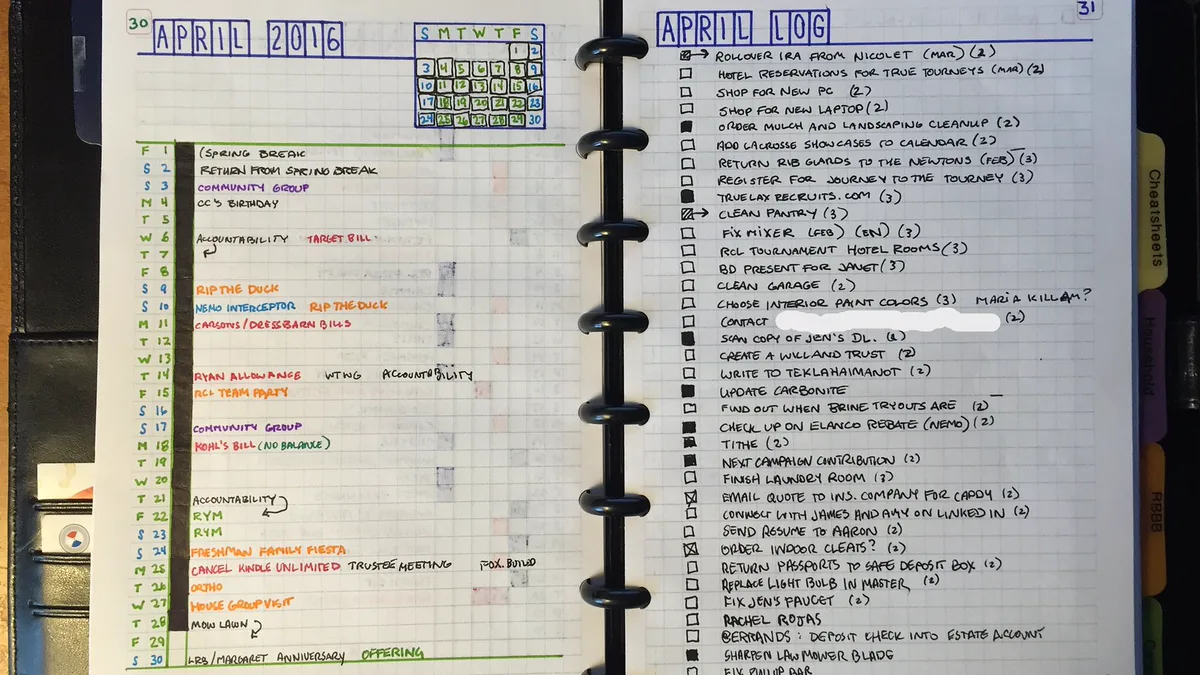
If you read a lot, use two tiers. Every book gets one line in the log, and only the books that stay with you get a full page. Mark the log line when a page exists, so the two stay connected.
In a thread asking for a reading journal that’s easy and low maintenance, the poster said they read more than 200 books a year, three or four at a time, with no patience to write up each one. The top reply suggested exactly this: a plain log of title, author, date and rating, pages only for the books you want, and a mark for which ones got a page.
Other low-effort reading journal ideas from the same thread:
- Printed pages in a disc-bound cover, with a sticky note reminding them to print more.
- One page per book in a plain lined journal, kept since 2001. Their grown children said it will matter to them one day.
- A template on a tablet, so the layout can change without wasting ink or paper.
Reading several books at once? Give each a sticky tab while it’s in progress, then move the notes to a page when you finish. The two-tier rule: the log is required, the page is a treat.
Is a digital or paper reading journal better?
Neither is better for everyone. Paper suits people who enjoy slowing down and want a keepsake; digital suits heavy readers who want search, backups and quick entries. Note-taking research shows the gap between handwriting and typing is smaller than people assume, so choose the format you’ll open most often.
The handwriting debate usually leans on a 2014 study by Pam Mueller and Daniel Oppenheimer in which students who typed lecture notes on laptops did worse on conceptual questions than students who wrote by hand. When Kayla Morehead, John Dunlosky and Katherine Rawson repeated that study, longhand did better only on factual questions in an immediate test, with no difference on conceptual questions and no significant difference two days later, according to a 2019 summary on the Learning Scientists blog. The lesson carries over: what you write matters more than what you write with.
| What matters to you | Paper journal | Digital journal |
|---|---|---|
| Speed of each entry | Slower, which some readers enjoy | Fast, especially for a one-line log |
| Finding an old note | Needs an index page or tabs | Search finds it in seconds |
| Changing the layout | Hard once pages are drawn | Easy, edit the template |
| Keeping it for years | A physical keepsake you can hand down | Needs backups and export |
| Screen time | None, good for a phone-free evening | Another reason to pick up the phone |
A hybrid works too: an app or spreadsheet for the log, paper for the pages that deserve slow thinking.
Book journal prompts for before, during and after a book
Book journal prompts work best when they match the moment: a couple before you start, one while you read, three right after you finish and one look back months later. That beats a long questionnaire you answer once.
There’s real support for writing about what you read. In Writing to Read, a 2010 report for Carnegie Corporation of New York, Steve Graham and Michael Hebert pooled studies from grades 1 to 12 and found that 57 of 61 outcomes (93%) were positive when students wrote about texts they read. Note-taking alone was positive in 21 of 23 comparisons for grades 3 to 12. That was school reading, but reactions, summaries and notes are exactly what a reading journal holds.
Before you start (pick one or two)
- Why this book, and why now?
- Who recommended it, and what did they say?
- What do you expect to feel by the last page?
- What does the first page promise?
- What do you already believe about this subject?
While you’re reading (one per sitting, at most)
- Which character would you have coffee with?
- What detail keeps coming back, and why might the author repeat it?
- What did you have to look up?
- Where did you stop last time, and what do you think happens next?
- Which sentence made you slow down?
- What’s confusing you right now?
- Where would you have chosen differently?
Right after you finish (choose three)
- Describe the book in one sentence to a friend who’s in a hurry.
- Which scene will you remember in a year?
- Did the ending feel earned, rushed or surprising?
- What did it change, even slightly, about how you see something?
- Who should read this next, and who shouldn’t?
- How did it make you feel on the last page?
- What question would you ask the author?
- What would you rate it today, and why that number?
- Which quote are you copying onto your quote page?
- Does it remind you of another book, film or season of your life?
- What will you read next because of this one?
A few months later (one line is enough)
- What do you still remember without checking?
- Has your rating changed?
- Did you recommend it to anyone? What happened?
- Would you reread it, and in what kind of week?
- What did you forget that your notes reminded you of?
- Did it lead you somewhere new?
- If you could keep only one page of this book, which would it be?
Copy the “right after” list onto a sticky tab inside the cover, so it’s always there.
How do you organize quotes in a reading journal?
Organize quotes by heading instead of by book. Give a page each to themes you care about, such as courage, home, grief or funny lines, and copy each quote under the heading it fits, with the book and page number. Later you can find a quote by what it means, not just where it came from.
This isn’t new. It’s how commonplace books worked. In an explainer on commonplace books and active reading published by the Folger Shakespeare Library in 2022, scholar Jason Scott-Warren describes readers setting up headings like death, love or God, then copying each relevant quotation under its heading as they read.
A simple way to try it:
- Pick five headings and add more as books suggest them.
- Leave two pages per heading and number them for an index.
- Note the book and page after every quote.
- Reread one heading between books. It’s a lovely way to choose what’s next.
As one reply in the books thread put it, your own stash of lines will interest you more than any list of famous quotes someone else gathered.
Why do reading journals get abandoned?
Reading journals usually get abandoned because the setup was too heavy to repeat. A spread that takes an hour to draw is fun in January and a chore by April. When the journal costs more effort than the reading, the notebook goes back on the shelf.
Maira Vial of Vial Designs wrote an honest look at the reading journal spreads she kept, changed and skipped. She began the year with detailed monthly spreads, then couldn’t recreate them every month once life got busy, and a reading-around-the-world page proved hard to keep up. Instead of quitting, she simplified.
So test any reading journal ideas you find before drawing them: would you happily redo this page every month in your busiest season? If not, make it a one-time page or skip it. Plain and kept beats beautiful and abandoned.
The other reason is guilt over a missed month. You haven’t broken anything. Log the book in your hand and carry on, and keep the journal where you read, next to the lamp in your reading nook, so it’s always in reach.
Reading journal myths, and what actually helps
Plenty of reading journal ideas online assume rules that make journaling harder. Let these go.
| Myth | What actually helps |
|---|---|
| You have to write about every book you read. | Log every book in one line and give pages only to the ones you want to, as the top reply in the low-maintenance thread suggested. |
| Handwriting always beats typing for memory. | In the 2019 replication by Morehead, Dunlosky and Rawson, longhand led only on immediate factual questions; there was no difference on conceptual questions, and none that was significant two days later. |
| A reading journal has to look like the ones on social media. | One reader in that thread has kept one plain page per book since 2001, and another said layouts can change as often as you like within the same journal. |
| A missed month means the journal failed. | Simplify instead of quitting, as Maira Vial did when detailed monthly spreads stopped fitting her schedule. |
If you’re keeping a journal to get back into the habit after a slow patch, the guide on how to get back into reading has a gentle two-week plan. You’ll find more on notes, logs and annotation in the Reading Journals & Notes section.
So which two of these reading journal ideas are you setting up tonight?
Between chapters
Can you start a reading journal in the middle of the year?
Yes. Make the book you’re reading now number one and list any earlier books you remember on the first page. A journal needs a first entry, not a January start.
What’s the difference between a reading journal and a reading log?
A reading log is a list: title, author, dates and maybe a rating. A reading journal can include that log plus your thoughts, quotes and plans. Many people keep the log as the first section of their journal.
How do you make a reading journal look nice if you can’t draw?
Use structure instead of art. Ruled boxes, one heading style, one accent color and some white space look tidy without drawing. Printed templates work too.
Can you keep a reading journal for audiobooks?
Of course. Log audiobooks like any other book and add the format in your log. Jot the chapter or timestamp of a line you loved and copy it later.
How long should a reading journal entry be?
As long as you want and no longer. One line in the log is a complete entry. For books that stayed with you, three prompt answers is plenty.
How we researched this: Book details (publication dates, series order, formats) are checked against the publisher and library catalogs. AI helped with an early draft; the writer rewrote it and checked every title.
Sources: Steve Graham and Michael Hebert for Carnegie Corporation of New York, Writing to Read report (2010); Carolina Kuepper-Tetzel, The Learning Scientists (2019) on Morehead, Dunlosky and Rawson; Folger Shakespeare Library, commonplace books explainer (2022); Maira Vial, Vial Designs (2026); reader discussions on r/readingjournals and r/books.
Leave a Reply
You must be logged in to post a comment.